Suleiman Wahed
All the Old KnivesSuleiman Wahed is one of the four Aslim Taslam hijackers aboard Royal Jordanian Flight 127, and the first to make the takeover openly violent. His actions on the aircraft begin with the killing of a stewardess and later bring him into direct conflict with a mother protecting her children.
Identity and Introduction
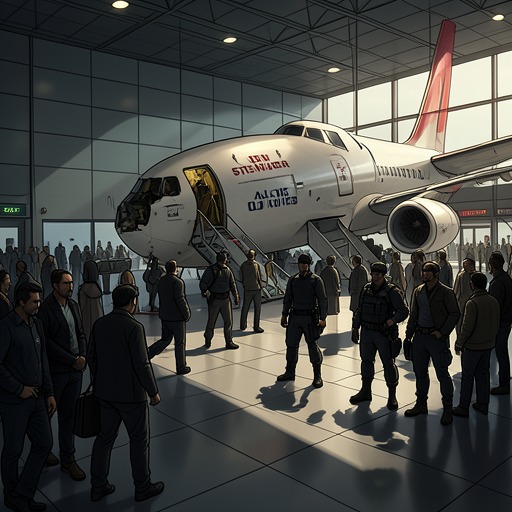
Wahed is a Pakistani national seated near the rear of the Airbus 319, which carries 120 passengers and crew on its flight from Amman to Vienna. The plane lands at 1:25 p.m. without incident; according to the information shared with the American team, the hijackers had caused no trouble during the three hours and fifty minutes in the air. Immediately after touchdown, Wahed unbuckles his belt and stands. When a stewardess rises, gestures for him to sit, and tells him to do so, he draws a pistol and shoots her in the chest. Her name is Raniyah Haddadin. Wahed’s sudden violence marks the transition from an apparently uneventful flight to a hostage crisis in which the hijackers’ demands place the lives of everyone aboard at risk.
Confrontation in the Cabin
During the hostage crisis, Wahed orders the children toward the front of the aircraft, first in Arabic and then in English. Seven rows ahead, Ibrahim Zahir is already escorting a five-year-old boy away from his mother. Wahed then turns his gun on Celia Favreau and demands that she surrender Evan and Ginny, threatening to kill them in front of her if she refuses. Celia rises partway from her seat to block his view of the children, but Wahed roughly pulls her into the aisle and reaches for them.
Ginny’s scream gives Celia her opening. She throws herself onto Wahed’s back, claws his face, and uses a hold she learned from a pirate to wrench his head until his neck breaks. Wahed falls, still gripping his pistol; Celia struggles it free as Zahir turns back, and the two fire at once. Zahir goes down, while Celia moves the little boy out of the way as another hijacker emerges from the cockpit. Wahed’s attempt to take the children thus ends in his death and a sudden reversal of control in the aisle.
Role in the Wider Crisis
Wahed’s violence unfolded within a coordinated hostage crisis: the hijackers identified themselves as members of Aslim Taslam and demanded the release of five prisoners—two held in Austria and three in Germany—within forty-eight hours. Officials were still verifying the report that seventeen Americans were aboard Royal Jordanian Flight 127; the passenger count also included twenty-nine Germans, making the governments’ response politically fraught as well as urgent. The deadline turned the passengers’ safety into the immediate stake of negotiations, while leaving open the possibility of an assault if Austria and Germany refused the demand.
The hijackers’ calls to the control tower and ORF, Austria’s national radio and television outlet, ensured that the crisis was watched from outside the aircraft. Television cameras were already at the airport fence, and their presence complicated any attempt to prepare a rescue discreetly: moving reporters away could itself prompt speculation that authorities were about to storm the plane. Wahed’s attacks therefore formed part of a confrontation whose pressure extended beyond the cabin, where the threat to hostages and the visibility of a possible response constrained the choices of officials.
Narrative Function and Characterization
Wahed is drawn through the information others can establish and the violence they witness, not through a disclosed motive or personal history. The briefing identifies him as Pakistani and places him near the rear of the aircraft, but the team has little beyond the hijackers’ names and passport photographs; the cabin scenes then define him by his pistol, his threats, and his attempt to seize the children. That narrowness makes him less a psychologically explained antagonist than the immediate human face of the hijacking’s lethal coercion. His death ends his part in the crisis, but the account offers no suggestion that it ends the danger aboard the aircraft.